
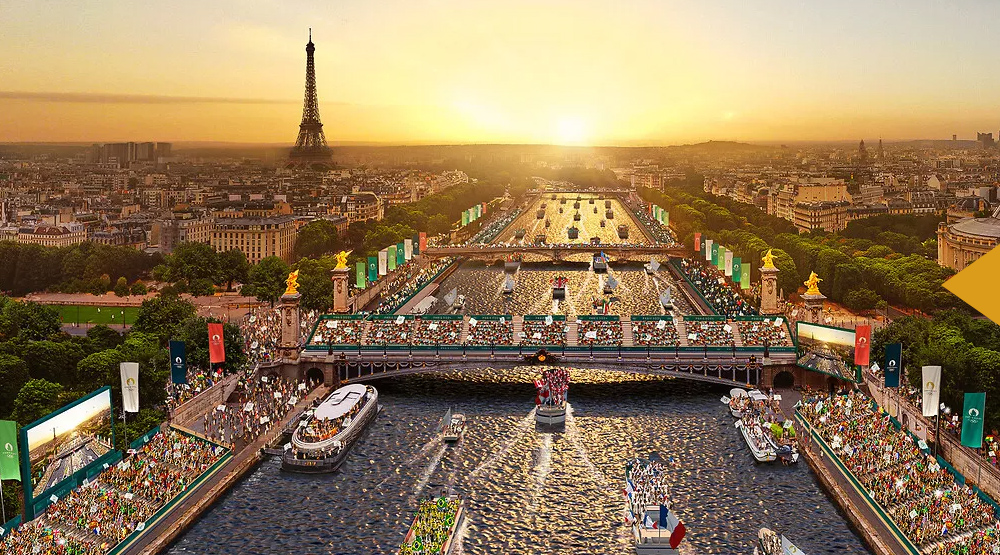
Another Summer Olympics has come to an end, and what a fabulous extravaganza it was! Despite the weather trying to ruin the opening ceremony, it was a celebration of the international camaraderie, and as we recap the magical memories we will take away from the events, it’s one point I must admit: this wasn’t another Olympic Games, and Paris broke many stereotypes. I hope the trend continues, and we will see the legacy to carry on in future games.
Paris at the heart
Paris is one of my favourite cities, and despite the last couple of visits not living up to my expectations, it had and always will have a special place in my mind. The organisers read that feeling well and put Paris at the heart of the Games. From the boats at the opening ceremony to using famous landmarks like Versailles and Grand Palais as the venues for the events to finishing long-distance runs at Trocadéro — it always felt that the Games was also a celebration for Paris. We have seen lavish venues being built, and we have seen countries struggling to maintain them and letting them fall into disrepair, but Paris showed that a different approach is possible. It showed that with imagination, creativity and industriousness, the same magical effects can be created without resorting to splurging money. Thomas Jolly, the artistic director of the ceremonies, did a fantastic job. Although nature ruined the opening ceremony, some of the moments felt even more sublime because of the rain, like the run of Amelia Mauresmo with the torch heading towards Jardin de Tuileries, La Marseillaise by Axelle Saint-Cirel, the Olympic flame lifted by the hot air balloons, or return of Céline Dion to the stage after a long hiatus. It was a celebration of the long history of the city– at times bloody, a celebration of the city as the global hub of art and culture, a commemoration of the women who played significant roles in the history of the city’s evolution.
Yusuf Dikeç
The stance! Left hand casually tucked away in the trouser pocket, an ordinary pair of glasses, eyes open while shooting — Yusuf Dikeç had every reason to become a meme; winning a silver medal at the Olympics is priceless. When I watched him at the gold medal bout, his casual style of shooting caught my eye. The hysteria that ensued was perhaps uncalled for, but who knows, he might as well have been a hitman. Let’s just say a lot of people took an interest in the Olympics because of Mr. Dikeç. His performance will remain one of the focal points of the first week of the Games.
Katie Ledecky
The. Most. Decorated. Female. Swimmer. Of. All. Times. Point!
What else could be said about the swimmer whose only competition is with her own times? Four gold medals in 800m freestyle for women’s, a record only held by nine other than Michael Phelps. Seeing her in Tokyo, I hoped she would go on until San Francisco, and what a momentous occasion it would be to add a fifth gold to her name at the same event! If she won a record 4th gold in 800m, she also defended her gold medal from Tokyo in 1500m freestyle, an event only introduced since the 2020 games. Long-distance swimming is a different scenario altogether. Let this sink in: after every 1500m swim, to cool down, Ledecky swam more than some of the short and mid-distance swimmers participating in multiple events would swim in the entire games! The race calls for superhuman levels of endurance and stamina, and to finish every race with more than a clear body length ahead of the second winner is a pure class act.
Léon Marchand
The poster boy of the French Olympic team, with his face pasted on every billboard over France, the pressure was immense on Léon Marchand to bring the best performance at the games. And did he deliver? The crowd cheered him on as he went on to become one of the phenomena of this year’s version of the Games. The French have rarely produced brilliant swimming stars – except the Manadous, let’s say. Léon Marchand has indeed broken that glass ceiling and presented himself to the world in an emphatic statement with four golds and a bronze. He was already being compared to Michael Phelps, and his butterfly was considered even better than Phelps’s. It will be a pity that Marchand’s medal tally may not end up as enviable as Phelps’s because almost half of his medals came in relays, and we all know how strong the USA relay teams are. On the other hand, France has a rare talent in Marchand, but with no other class performers, will most likely be out of any medal contention. Nevertheless, Marchand is here to stay for a long time, and when he retires, he can rejoice in a lifetime supply of takeaways.
Summer McIntosh
If the great Katie Ledecky is entering her twilight years after this Olympics, we are witnessing the dawn of another great swimmer, this time from neighbouring Canada. It is a surprising fact that at the age of 17, this was Summer’s second Olympics. She finished an impressive 4th in Tokyo behind Ariarne Titmus and the great Katie Ledecky. If in the men’s section, it was Léon Marchand’s Olympics, certainly for women’s, it was McIntosh. She has a long career ahead of her, but like Léon Marchand, Summer will probably carry on as a live ranger with not many model prospects from relays.
Kaylee McKeown
I needed to include Kaylee McKeown as one of the best athletes in this game, not just because of her defending the back-to-back 100m and 200m backstroke golds but for the strange fact that we share the same birthday. Kaylee is a fabulous swimmer, but she scooped up three more medals outside of her main events, taking her tally to five. We often see a star-studded and much-hyped Olympics contingent. Kaylee was not in the limelight within the crowd of Ledecky, Emma McKeon, Summer McIntosh, Ariarne Titmus, and so on. Yet, she has quietly become the sixth most decorated female swimmer at the Olympics. San Francisco will witness Kaylee trying to even the record of none other than Krisztina Egerszegi of winning three backstroke golds in 200m. She might even do better and go for a double — a feat that will place her in the Hall of Fame of the Greatest Swimmers of All Time.
Joker
Novak Djokovic is not everybody’s cup of tea. He has made controversial statements in the past, which earned him criticism in a world that is now conformist, but no matter how you dislike him, nothing takes away his greatness and achievements. In his long career, Djokovic won every tournament he could, apart from the elusive Olympic gold. This Olympics would have been his last chance to complete his medal/trophy cabinet, and he finally achieved the feat in a gruelling final. He would still be the greatest of all time, ahead of Federer and Nadal, even if he didn’t manage to clinch the title at Roland-Garros, but the pure emotions he displayed after the victory showed how desperately he wanted to win it.
Simone Biles
Simone Biles is undoubtedly the most celebrated gymnast of this era, and her extraordinary talent has inspired many to become interested in gymnastics. In Paris, she extended her medal tally to 11 with three golds and a silver, returning to her stellar form in Rio. Paris Games will be remembered for the great rivalry and camaraderie between Simone and the Brazilian Rebeca Andrade. Yet the most significant contribution of Simon to the sport is her decision to withdraw from a number of events at the Tokyo Olympics, motivating athletes and people in general to speak about mental health. Her decision drew criticism as well, but they were politically motivated. Simone’s return to the podium silenced her critics and sealed her position as one of the finest gymnasts of all time, with only the great Larisa Latynina ahead of her in the total medal count.
Imane Khelif
Like previous games, the Paris chapter of the Olympics wasn’t devoid of its fair share of controversies. There are three athletes who stole the spotlight when it came to social media attention. I’ll come to the third one later, but unlike adulation and manga that followed Yousuf Dikeç, things turned pretty nasty for Imane Khelif. The controversy broke out after her Italian opponent Angela Carini resigned, complaining she had never been hit this hard by another woman before. It turned out that she was disqualified by the International Boxing Association (IBA), failing eligibility requirements, and misinformation spread through wildfire that she was transgender, had XY chromosomes, etc. The public wrath not only befell on Imane but generally on transgender people, their place in society and so on. Needless to say, this furore would have had a massive effect on Imane’s concentration. Yet, she did not lose focus and carried on winning all her bouts to a gold medal. Imane’s success will serve as a shining beacon for people to never lose their focus no matter how much everything and everyone gangs up against them. It’s never easy to go against the tide, and I hope Imane’s fight continues outside the rings, as she took to court the likes of JK Rowling and Elon Musk for fomenting cyberbullying.
Skateboard, BMX, Climbing
If we remember the fierce rivalry during the Cold War era between the Soviet and eastern bloc nations and the so-called West — that is a thing of the past. The West has found a new enemy in China and has questionable medical records. There are still many arch-rivalries between teams and athletes, but since the Tokyo games, we are witnessing a reverse trend. These games are relatively new additions to the Olympics, and we don’t have historic scores to settle. Skateboarding, BMX, Climbing — we witnessed a sense of camaraderie and bond amongst the athletes that was previously unthinkable. We are not talking about showing sportsmanship by being civil to your opponents, but we see other contenders cheering for each participant; there are fist bumps and hugs after every turn as the athletes are there to celebrate the fourth motto of the games — ‘together’. Of course, they are there to win, but it’s about giving your best performance whilst celebrating your joy and pain with your co-participants. We must not forget that these sports are social activities, things people do to ‘hang out’, so the atmosphere is much more relaxed, and the sense of bonding and friendship is palpable. We hope other sports also follow their example and that the arch rivalry between teams, countries, and individuals will see a slow decline before we no longer resort to aggression, abuse, and ridicule when it comes to opponents.
Raygun
We spoke about two internet sensations in previous sections. If the ‘Turkish hitman’ Yousuf Dikeç ruled social media in the first week of the Olympics, it’s surely the Australian breaker who goes by the name Raygun, who dominated the attention during the second week. Unlike adoration for Dikeç or malice for Imane Khelif, Raygun became a meme for her non-performance, as she ended her tournament failing to secure any points. The selection of breaking as an Olympic sport is a dubious decision, and you come across better break dancers on street corners. Nevertheless, where sports can be seen as a means of enjoyment, no doubt Raygun does enjoy breaking, but at a competitive level, she came up with a kangaroo jump. The mockery and abuse thrown at her was undeserved, and she showed great courage to show her breakdancing moves in the streets of Paris. She opened up to the media and is another example of being courageous when confronted with harsh criticism. Time will tell if Rachel Gunn, the professor of media and communications at a university in Australia, will be remembered for the useless memes created of her by faceless trolls or her carefree way of dealing with them and going on enjoying what she did. One thing is certain: breaking won’t be missed at San Francisco games.
Femke Bol
Many records were slashed during the Paris games, and it’s impossible to speak about each of them. Yet, I must mention Femke Bol’s performance in the 4×400 mixed relay was a coup de force and enthralling to watch. It was the last lap. First, three teams had already done their baton changes and were well underway for the last lap. In fourth place was the Netherlands. They ran well, yet 12-13m behind the third-place runners when Femke Bol took the baton. What we witnessed next was nothing short of a fantasy. We saw the distance reduce between the third and fourth, then she took over the second, and within the last 30m, she was in the front. By the time she finished the race, she was well over 10m ahead. After she pulled such an inhuman feat, we expected similar results for the 400m flat and hurdles. Femke ended the games with three medals, but the colour of the medals didn’t do justice to her potential.
Armand Duplantis
During my teens, I grew up watching Sergei Bubka topple one after another pole vault records. After his retirement, the pole vault lost its attraction to some extent, with no exceptional talent coming forward. I can definitely say the drought is over with the arrival of Armand Duplantis. As we have seen in other events, like Katie Ledecky in 1500m freestyle, Duplantis is in a league of his own, with only his records to break. In Paris, Duplantis set another world record, breaking his previous one. By the distance he cleared the bar, it was evident that he could better his record by many centimetres. One wonders, though, with so much potential, why he always puts the bar by 1cm whenever he tries for a new world record. I think the answer is why Apple adds a tiny amount of upgrades to their equipment every year. To keep people guessing how far he can go.
Arshad Nadeem
When we speak about sports uniting people and breaking boundaries, it is worth noting the thrilling performance of Arshad Nadeem from Pakistan, which secured the country’s first-ever medal in athletics. The defending javelin champion, Neeraj Chopra from India, was hopeful for the top spot, but the sheer power of Nadeem stunned the rest of the finalists and broke many hearts of Indian sports fans. Due to the heightened political tension between the two neighbouring countries, one would have expected that there would be many confrontations between the two competitors, but they both showed mutual respect, and when spoken to their families, both replied that the other was like a son to them. Of course, the nationalist and extremist factions had problems accepting such a calm and warm message, but the reactions observed from the general public in India was that it was rather Chopra who won it, but Nadeem’s victory hasn’t generated as much bitterness. Why would it, when you find out how he lives with his family and couldn’t even afford the javelin until a crowdfunding initiative raised enough money for his kit? Let’s hope Nadeem continues being the great athlete he is, and perhaps this can show the roads to the end of the India-Pakistan archenemy narrative.
Sifan Hassan
When I was young, people used to ask a trick question — who would win the race if the two animals ran for an hour, a panther or a horse? The naïve mind replied panther, only to realise later that speed is flashy and flamboyant, but endurance is something that takes you further in the long run. Sifan Hassan is a perfect example of how these two qualities blend perfectly to create a unique combination. In Tokyo, she won gold in 5000n and 10000m, which are considered long-distance runs, but she also won a bronze in 1500m, which is mid-distance and often needs faster legs. Sifan won bronze in 5k and 10k in this year’s version but won gold in the marathon. Although marathon is a long-distance event, the distance is significantly higher than 5 or 10k and is put in a different category of its own. Winning a treble is a remarkable feat; considering Sifan had to sprint for the last leg of her marathon performance, it made it even more extraordinary, proving that she is a perfect combination of speed and endurance. The only woman to win gold in these three races, Sifan will surely have a place in the hall of fame with an achievement that will not be broken for many years.
Women’s basketball final
The last event for this year’s Olympics was the women’s basketball final between defending champions USA and the host country France. At first view, this was no more significant than any other gold medal match, but in reality, it meant a lot to both teams. France, after a brilliant Games boosted by the home crowd, wanted to stretch its medal haul to one more gold medal and end the games on a high note. The USA, on the other hand, has seen a dwindling dominance of their star-studded ‘dream team’ as the other countries grew stronger over the years. Also, despite having won many more medals than China, they were one gold behind, which meant China was still on top of the medal tally. Since the dissolution of the Soviet Union, American dominance at the top of the medal table became a de facto status, with the exception of Beijing. Whilst China has challenged the US’s top position, they mostly finished a close second. So it was all at stake for both teams to go the extra mile, and what a cliff-hanger finale it was! France didn’t give an extra inch to the American team, and whilst they broke free of the French defence in the last few minutes of the game, the French came back strong. It was only seconds away, with three points behind. The French needed a miracle to get into the extra time, and they scored a long shot after the hooter went off, only to find that the player just stepped onto the circle, and the French lost just by one point. The jubilant US team made the gold tally to 40, but with higher silver counts, they ended at the top position in the table. But it is clear that the American domination at the greatest show on earth is under serious threat.
Changing landscape of medals
From the beginning of this year’s games, it was noticed that medals are just not split amongst a few nations; the playing field has indeed been levelled. After many years, the USA just clinched the top spot in the medal tally thanks to the last event of the tournament – the women’s basketball final. The US was still a long way ahead of the rest of the countries in total medal count, but their gold medal haul has significantly dwindled. The rise of China as the second most successful contingent is no longer a surprise, but we will possibly see fierce competition for the top spot in the coming years, reminding us of the Cold War period rivalry between the USSR and the USA. Many other countries are investing more in their sports infrastructure and training with expert coaches, and the medal table is a true reflection of that changing landscape. The next Games will take place in America after 32 years, and it will be interesting to see how Team USA does in front of the home crowd. However, we need to question whether sports is a profession or a hobby. Is it meant for recreation or business? I was watching a documentary on how the French Olympic team practised and how, with the help of science and technology, they are producing 100% of their capabilities. Then you hear stories about Chinese divers who practice 12 hours a day non-stop, with no exceptions. And this makes you wonder, in one sense, they are living up to the motto of the modern Olympics – faster, higher, stronger; but on the other hand, is it worth it? Could other competitors be like Raygun, with a career and taking up breaking as a hobby and not being great at it? Where is the fine line? But there must be one!
Controversy
Paris did have its fair share of controversies even before the games officially started. We have mentioned a few above, but here’s a list of the controversial moments that come to mind in a non-chronological order:
- The Argentina—Tunisia football match was stopped for two hours following a pitch invasion by supporters. Tunisia won the game but in an empty stadium.
- The choice by the organising committee to feature Lady Gaga for the burlesque performance to remember the Parisian dancers was odd; it could have been an ideal opportunity to feature a cabaret performer whilst the trend is o the decline.
- Imane Khelif and the mass hysteria about her being transgender made her subjected to much malice on social media.
- Rape convict Steven van de Velde represented the Netherlands in beach volleyball, and there wasn’t anywhere near as much public outcry around him as were the false accusations of Imane Khelif being a man.
- The opening ceremony celebrated the Greek roots by creating a scene featuring Dionysus, the god of festivity. However, to the spectators, the scene appeared to be a mockery of the Last Supper. This drew harsh criticism from the Vatican and other Christian churches, which prompted the organisers to make major changes to the closing ceremony to eliminate any scope for criticism.
- Vegan food formed a large part of the food served to the athletes in the Olympic Village, which drew much criticism, more from the anti-vegan enthusiasts than the athletes themselves.
- Many athletes questioned the quality of the accommodation and beds. They may have a point, but considering the immensity of the event, as many other athletes pointed out, it comes as part and parcel of the competition, so you cannot keep complaining.
- The British team brought their own chef, as they thought the French cuisine was not cooked enough for their palate. Considering the blandness of British food, I wonder what the chef served.
- Suspicious disqualification of Vinesh Phogat, the Indian wrestler who was sent to compete in 50kg category to make space for another medal hopeful in her natural 53kg group. She was about to go on the gold medal bout when before the match she was found to be 100gm heavier than the weight limit for the category. It is quite normal for the wrestlers, boxers and weightlifters to see a rapid weight gain or loss, but the suspicious part of it was that complete inaction from the Indian Olympic team management. It might be a coincidence but Phogat took to the streets last year protesting against the government, demanding suspension of a senior official over allegations for sexual offences on female wrestlers.
- The water quality of Seine delayed the triathlon by three days. The event eventually went ahead, but many athletes taking part in events involving swimming in the Seine have reported being sick. Perhaps it was one step too far to use the whole of Paris as the venue for the events.
Legacy
People often talk about the legacy of the Olympic Games, what it brings to the hosts, and what impact it leaves on the annals of history. Showing some shiny Olympic venues may be an example; there may be economic indicators about how the surrounding areas are doing before and after the games. It could end up like Athens 2004, with infrastructure being abandoned and falling into disrepair, or it could be an example of London 2012 where the Olympic village and surrounding areas have been transformed magnificently, attracting investment and creating employment although making local people being priced out to buy properties in the area. Admittedly, the event is a window to a country’s economic, cultural, ethical and technological potential, and in that sense, host nations try to present the best they have on offer. I think the legacy of this chapter of the Olympic Games is that it is one of the greenest games and that the state didn’t have to spend an obscene amount of money to make this event successful. It also was the first Olympics with 100% equal representation – featuring equal number of male and female performance. This will definitely set the standards for future games. The legacy would be how Paris made the entire city the stage for the grand spectacle. From the opening ceremony to all the little changes during the events— from coups de batons to bell ringing by the champions — the event screamed out that it was unique, extraordinary, and French. Overall, the Paris Olympics helped the city and France cement its position as the hub for soft power in Europe.
 Pensées...Rêves...Cauchemars...Éspoirs